Your Service Doesn’t Make Someone Else’s Matter Less
I’ve been called a lot of things in my life, and most recently I was called a coward and a fake.
The last time someone challenged my courage was my teenage son, who tried to goad me into riding a roller coaster. But after consuming a pretzel, churro, popcorn, and 24 ounces of soda immediately beforehand, I was confident in my decision to accept his criticism.
This time felt different.
The words came from a fellow veteran—someone I served alongside on the battlefield. My immediate instinct was to clap back, defend my service, and point out everything I thought was wrong with his. Then I realized that by doing so, I would be participating in the same behavior that bothered me in the first place.
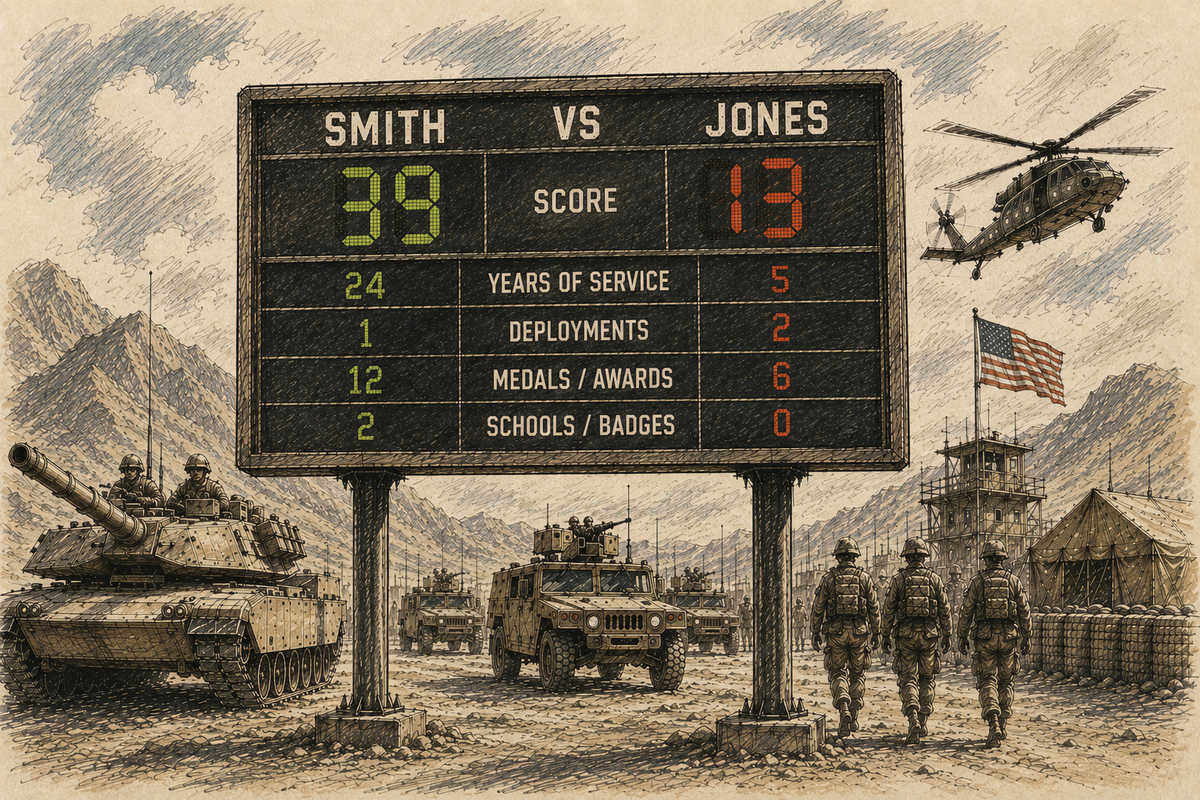
More and more, I see veterans criticizing other veterans’ service as though we are competing against one another. Branch, MOS, combat experience, years served, tabs, badges, schools, training, medals, and decorations become points on an imaginary scoreboard.
Maybe I missed the memo where we accumulate enough points and eventually win something.
This isn't an argument that all service is equal, that accomplishments don't matter, or that veterans shouldn't call out dishonesty. Standards matter. Facts matter. There are differences between serving in combat and never deploying, between honorable service and extraordinary acts of courage, and between earning an award and falsely claiming one. Those distinctions should never be erased.
I also understand why veterans are protective of military service. I am too. When someone falsely claims an award, combat experience, or service they didn't earn—or deliberately exaggerates what they did to gain status, opportunity, or some other personal benefit—it cheapens what others actually did.
But protecting the integrity of military service should make us more committed to getting the facts right—not more willing to publicly condemn someone before we have them. If another veteran's story doesn't add up, ask. Give them an opportunity to explain, correct the record, or make things right before assuming the worst. There should be an escalation of force in how we respond. Start with a conversation. If the facts prove false or deliberately misleading and the person refuses to correct them, a stronger response may be warranted—including, in some circumstances, a public one. If the facts are true but the telling has become self-aggrandizing, perhaps the better response is a reminder about humility rather than an attack on the service itself.
And if, after being given every reasonable opportunity to correct the record, someone continues to knowingly make false or exaggerated claims, the consequences belong to them. They have diminished their own service through their actions. The rest of us don't need to do it for them.
There is also a line between fact and judgment. A truthful account of someone's service doesn't become an exaggeration simply because another veteran believes that person wasn't brave enough, didn't sacrifice enough, or didn't serve the way they think they should have. At that point, we aren't correcting the record. We're substituting our own judgment for it.
Recognizing differences in service is not the same thing as using them to determine who is worthy of respect as a veteran. Achievement is not a license to diminish someone else's honorable service.
As soldiers, we are taught that the team comes before the individual. Yet when veterans use what they accomplished to establish their superiority over other veterans, we abandon that principle.
I’ve had the privilege of meeting several Medal of Honor recipients. These remarkable people never treated me as inferior. They were humble and gracious, and they thanked every veteran they spoke with for their service. They weren't measuring their accomplishments against anyone else's—and if anyone had earned the right to do so, it would have been them.
Which brings me back to being called a coward and a fake.
I don’t know why this individual chose to publicly question my service. Perhaps he believed I was misrepresenting it. I wish he had simply reached out and asked.
I would have told him that I did not receive my Purple Heart while serving in Iraq. It came 17 years later.
My Purple Heart was awarded for a Traumatic Brain Injury (TBI) after being hit by several IEDs I was diagnosed and treated for TBI. The recognition came years later because the military's standards for evaluating concussion and TBI for the Purple Heart evolved after my deployment, with later guidance applying to qualifying injuries dating back to September 11, 2001.
At the time, I didn’t talk about my diagnosis. There was considerable stigma surrounding TBI and mental health conditions. I worried about promotion, being ostracized, being forced to change my MOS, losing the opportunity to command, or simply being told that a TBI wasn't a “real” wound. So someone who served with me could very easily have had no idea I was dealing with a TBI.
Seventeen years later, the Army reviewed the circumstances and awarded me the Purple Heart.
But my experience reminded me of something larger than my own situation: we sometimes know remarkably little about the people we served beside.
Someone can know where you deployed, what job you held, and even have shared the battlespace with you and still not know your entire story. Not every wound is visible. Not every act of service becomes a story someone tells. And not every veteran feels compelled to explain everything they experienced.
That's one reason we should be careful before deciding we know enough about another veteran's service to judge it.
That addresses the “fake” accusation. Being called a coward is different.
This wasn't coming from a stranger questioning something he couldn't have known. It came from someone who served with me in Iraq. The implication wasn't subtle: that I avoided danger, stayed safely out of the fight, and therefore couldn't possibly have sustained the injury for which I was later recognized.
I know that isn't true.
I know where I was, what I did, and what I experienced during 13 months in Iraq. I know the missions we ran, the IEDs we encountered, and the circumstances that ultimately led to my diagnosis.
But this is where the distinction between fact and judgment becomes important. Another veteran may have an opinion about how someone served. They may believe they were braver, endured more, or would have acted differently. They should not turn that opinion into a different set of facts. A veteran's own experience can give them perspective on someone else's service, but it does not give them ownership over it.
I don't need to reconstruct my deployment here or list combat experiences, positions, or awards to prove I wasn't a coward.
In fact, doing that would undermine the point I'm trying to make.
I could respond by comparing my service to his. I could start counting missions, awards, positions, or experiences and build my own case for why one of us supposedly served “better” than the other.
But then I'm right back at the scoreboard.
I'm proud of how I conducted myself in Iraq. I'm proud of the soldiers I led and served beside, including people whose experiences and accomplishments were different from mine. When I talk about my own service, I let the facts stand on their own. I don't embellish them or make my service into something more than it was.
That's enough for me.
Because I’m a history nerd, I tend to connect things back to the past. And in this case, the history of the Purple Heart itself seems particularly relevant.
In 1782, George Washington created the Badge of Military Merit, the precursor to today's Purple Heart. It was intended to recognize exceptional merit, but it also reflected another important principle: the opportunity for military recognition should not belong only to officers or those of a particular rank or status.
Washington opened that opportunity across the ranks of his army. As he put it:
“The road to glory in a patriot army and a free country is thus open to all.”
But another part of that history matters.
Earning the Badge distinguished what a soldier had done. It did not elevate his rank or diminish the standing of the soldiers around him.
The recognition honored merit. It wasn't a declaration of greater personal worth.
That's an important distinction.
Washington demonstrated that extraordinary service could be recognized without suggesting that everyone who hadn't received that recognition was somehow lesser.
The award elevated the achievement without diminishing everyone else's service.
That may be the lesson from 1782 that matters most today.
We should absolutely recognize differences in service. Some veterans did extraordinary things. Some endured tremendous sacrifice. Some earned distinctions that very few people ever will. They deserve those honors.
But an award recognizes something you did. A tab or badge represents something you accomplished. An MOS tells us something about how you served. A deployment tells part of your story.
None of those requires another veteran's honorable service to become less valuable by comparison.
And there is an irony I can't overlook in all of this. The decoration at the center of the accusation against me traces its lineage to the distinction Washington created while articulating the principle that “the road to glory” should be open to all who earned it.
Nearly 250 years later, perhaps we should remember what military recognition is supposed to do.
Recognize excellence. Honor sacrifice. Preserve standards.
Not create a scoreboard for deciding whose honorable service matters more.
We should challenge dishonesty when we encounter it. But protecting the integrity of military service also means getting the facts right before attacking someone else's. Ask questions before making accusations. Correct falsehoods when the facts warrant it. Encourage humility when ego overtakes service. And recognize the difference between protecting the integrity of military service and imposing our own judgment on someone else's.
There are enough people willing to tear veterans down.
We shouldn't be doing it to each other.
Postscript: After I began writing this essay, the veteran whose comments prompted it and I had an opportunity to talk. It was a productive conversation and reinforced one of the points I make here: when something doesn't add up, start with a conversation. We may not always agree, but talking to each other is usually a better place to begin than talking about each other.